Are the Things a Human Being Can Think the Same as the Things They Can Say?
At first glance, this question appears simple. Most of us assume that thought comes first and that language is merely a tool used to express it. Ideas form in our minds, and then we convert those ideas into words. Language seems like a transport system. Thought is the cargo, and language is the vehicle that carries it. However, when we examine the issue more closely, this distinction begins to appear far less clear.
This is because the human mind may not be merely a system that uses language. Perhaps language itself plays an active role in shaping thought. Perhaps some thoughts exist only because certain words exist. Perhaps part of the way we perceive the world is determined, without our awareness, by the language we use. An even more interesting question is this:
If language influences thought, then what exists in the places language cannot reach?
Perhaps the deepest regions of the human mind begin precisely where language ends.
Did Humans Begin by Thinking or by Speaking?
Language did not emerge at the same moment the human species first appeared. For millions of years, our ancestors produced complex sounds, used gestures, and communicated with those around them. However, symbolic language in the sense that we understand it today emerged much later. This distinction is important.
Because communication and language are not the same thing.
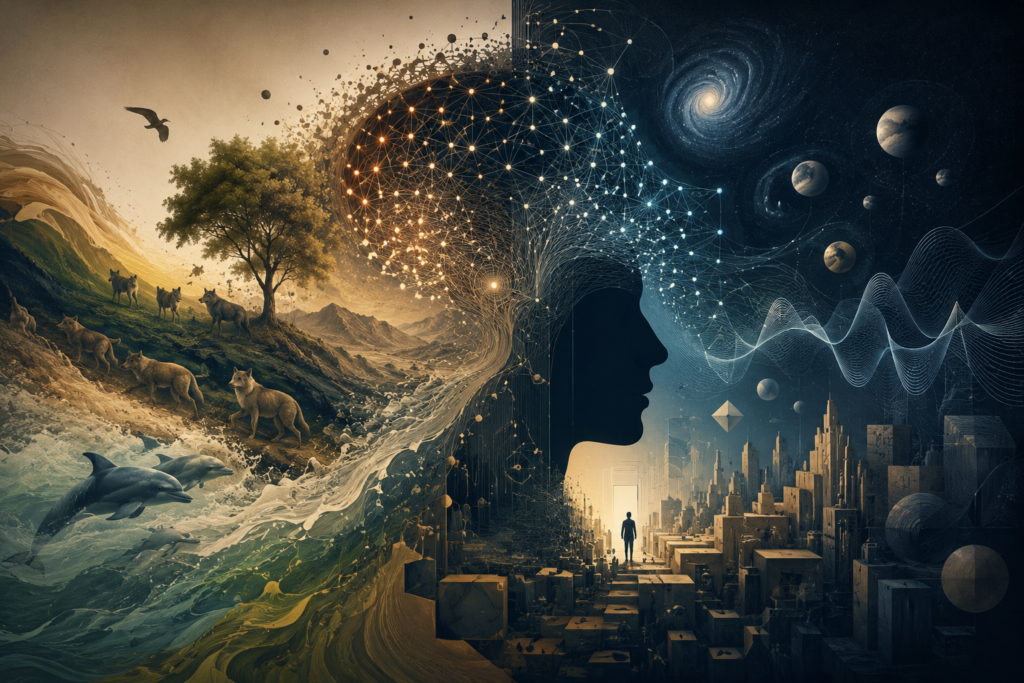
A pack of wolves can communicate, and a dolphin can transmit information through sounds. Yet none of these can do exactly what human language does. Human language does not merely describe what already exists; it can also create things that do not exist. It can speak of events that have never happened. It can imagine futures that have not yet occurred. It can construct worlds that do not exist at all.
For this reason, some researchers believe that symbolic language lies at the foundation of human civilization, even before tools or fire. The ability to imagine something collectively may be a prerequisite for building it in the physical world.
A city is born not first from stones, but from a shared story constructed in the mind. A religion emerges not first from temples, but from shared meanings. For this reason, language appears not only as the product of thought, but also as a structure that organizes thought itself.
Can Thought Exist Without Language?
At this point, an interesting problem emerges. If language is the foundation of thought, does that mean that beings incapable of speech cannot think?
Does an infant think nothing before learning language?
Does a dog not experience fear?
Does a bird not make plans?
Today, neuroscience and cognitive science largely answer these questions with a no. Thought can exist without language. However, what kind of thought this is remains a subject of debate. When a person sees a tennis ball moving through the air, they do not consciously perform mathematical calculations to determine its speed and trajectory. Yet the brain carries out these calculations nonetheless.
A musician can understand and feel a melody without translating every note into words.
A painter may carry an image in their mind that they are unable to describe.
A mother may struggle to explain her love for her child, yet that feeling undeniably exists.
These examples suggest that there are layers of the mind that operate before words. Perhaps thought is not a single thing. Perhaps some thoughts are linguistic, some are visual, some are emotional, and some are entirely abstract structures. If that is the case, then the question itself begins to change.
Rather than asking, “Can thought exist without language?”
we may need to ask:
“What kinds of thoughts can exist where language does not?”
How Do Words Divide the World?
When a child enters the world, they are confronted with an immense flow of colors, sounds, smells, and movements. Yet when an adult looks at that same world, they see objects: a table, a tree, a cat, a person, a cloud. A significant part of this distinction is created through language.
Language constantly divides reality into categories. It draws boundaries, assigns names, and creates groups. In doing so, a universe of infinite variety is transformed into manageable mental pieces. But there is a problem here.
Is reality truly divided into these categories?
Or are we the ones creating the divisions?
For example, where exactly does a mountain end and a hill begin in nature?
At what precise point does a color stop being blue and become green?
Exactly when does childhood end and adulthood begin?
Nature rarely contains sharp boundaries. More often than not, it is language that creates them. For this reason, some philosophers have argued that words do more than describe the world—they help shape it.
Reality Living Within Language
A significant portion of twentieth-century research on language was driven by a fascinating question:
Could different languages create different realities?
In some languages, directions are described not through left and right, but through north, south, east, and west. Studies have shown that people who speak such languages often develop extraordinary navigational abilities.
In some languages, time is imagined as a line moving toward the future, while in others it is conceptualized in entirely different spatial ways. Some societies possess dozens of words for snow, while others have developed highly detailed naming systems for family relationships and kinship.
The central claim of the approach known as linguistic relativity is this:
The language we speak does not merely express the world; it also influences how we perceive it.
The more extreme interpretations of this idea are no longer widely accepted today. However, it is becoming increasingly difficult to argue that language has no influence on perception at all. The brain tends to direct its attention toward things it can name.
Giving something a name may be one way of making it visible.
The Language of Our Inner Voice
Now let’s move into more personal territory. Take a moment and try to think in silence.
What is happening inside your mind?
For most people, the answer is surprising. There seems to be someone constantly talking inside the mind.
It asks questions.
It provides answers.
It makes plans.
It replays the past.
It simulates the future.
A large part of this inner voice relies on language.
For this reason, some researchers believe that language is not merely a tool for communication, but also the method through which the mind speaks to itself.
Perhaps part of what we call consciousness is the result of this continuous dialogue the brain conducts with itself.
Yet another paradox emerges here. If consciousness depends on inner speech, then what is consciousness before speech?
What is the experience of an infant like?
How does awareness function in an animal?
When a person enters a state of deep meditation and the inner voice falls silent, what remains?
None of these questions has a definitive answer.
Places Beyond the Reach of Language
Some experiences seem to resist language. Love, death, profound grief, birth, mystical experiences, or intense aesthetic encounters are among those experiences that people often struggle to fully describe, even after they have lived through them. For this reason, many people find themselves falling back on the same sentence when trying to explain the most important moments of their lives: “I can’t describe it.” At first glance, this may seem like a limitation, but it may actually point to something deeper. The experience is real; the person has lived it, felt its impact, and it may even have changed the course of their life. Yet language does not seem capable of carrying the entirety of that experience.
This raises the question of whether certain layers of the mind are broader than words themselves. Perhaps language can express only the visible part of thought and experience. Like waves forming on the surface of an ocean. The visible movements occur on the surface, but most of the processes that create them take place in the depths. Something similar may be true of the human mind. Feelings, intuitions, associations, and certain states of consciousness may remain beyond words for a long time, either before they emerge or even after they do.
Music provides an interesting example of this. A single melody can sometimes take a person back many years, evoke an intense sense of longing, or awaken an emotion that is difficult to explain. Yet when asked why they are affected by it, most people cannot provide a clear answer. In a similar way, certain feelings that arise while looking at a landscape, standing before a painting, or gazing at the night sky seem to come before words. It is as if the experience occurs first, and language only later attempts to capture it. For this reason, some thinkers have argued that art, music, and aesthetic experiences can reach places that language cannot. Perhaps the entirety of human experience can never be fully translated into words.
Mathematics and the Strange Language of the Universe
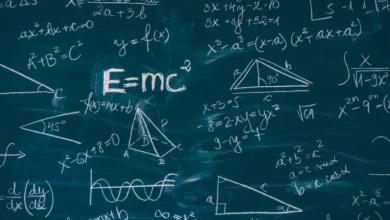
An interesting example that challenges the idea that language limits thought is mathematics. Mathematics is not an ordinary language. It uses symbols instead of words, remains largely unchanged across cultures, and often possesses a structure entirely different from everyday speech. Yet its success in explaining the workings of the universe is remarkable. From the movements of galaxies to quantum fields, from black holes to the informational structure of DNA, many phenomena can be described through mathematical expressions.
The question that emerges here is not merely that mathematics works. The real question is why it works so well. If mathematics is an invention of the human mind, why does the universe seem to conform so closely to its rules? If mathematics is something discovered, are we speaking of a realm of reality that exists independently of human beings? Did numbers and mathematical relationships exist before humans appeared, or is it the human mind that gives them meaning?
This question has been debated for centuries and still has no definitive answer today. Yet the discussion itself offers an important clue. Mathematics suggests that thought is not composed solely of spoken language. A mathematician solving a complex problem does not always think in words. Sometimes they see relationships, sense patterns, or recognize connections between forms. For this reason, mathematics suggests that the human mind may possess modes of thinking that extend beyond spoken language. Perhaps thought is not merely a process made of words. Perhaps mathematics, music, and visual thinking are other languages used by the mind.
Artificial Intelligence and a New Mirror
The rise of artificial intelligence has revived this discussion. For the first time, a non-human system can use language to generate responses that appear meaningful. This has led many people to ask the same question: Could a system that uses language be thinking? This question is not only about machines. It opens the door to a much deeper discussion about how the human mind itself works.
Perhaps the first question that should be asked here is what thinking actually is. If thought consists only of processing symbols, machines seem capable of doing that to a certain extent. However, if thought requires subjective experience, the situation changes. Knowing something and experiencing it are not the same thing. A system may talk about love, explain the concept of death, or describe pain. Yet whether it truly experiences these things is an entirely different question.
For this reason, the debate surrounding artificial intelligence is gradually transforming from a discussion about technology into a discussion about consciousness. To determine whether machines can think, we first need to understand what human thought actually is. Yet consciousness, subjective experience, and the nature of thought remain unsolved problems even today. Artificial intelligence is therefore not merely a new technology; it also appears to be a new mirror held up to the human mind. As we look at machines, we may in fact be trying to understand what our own minds really are.
Are the Limits of the Language We Speak the Limits of Our World?
Perhaps there is no definitive answer to this question. Language may appear to limit thought because we struggle to understand things we cannot name, and as we develop new concepts, we gain access to new ways of thinking. The history of science is filled with examples of this. Before concepts such as the atom, the gene, the black hole, or the quantum field emerged, people could not think about these ideas in the way we do today. New words sometimes open entirely new territories of thought.
At the same time, however, thought seems capable of transcending language. A child’s first fear comes before words. A person may be unable to describe what they feel for years, yet continue to live with that feeling nonetheless. This suggests that at least part of thought may exist independently of language.
For this reason, it may be more accurate to think of language not as a prison, but as a map. Maps are immensely valuable; they help us find our way and make complex landscapes understandable. Yet no map is the entirety of the world it represents. Reality is always larger than the map. Perhaps language is the same. It does not encompass the whole of the human mind, but it remains one of the most powerful tools we possess for reaching it.
At this point, the question returns once again. Perhaps the real issue is not whether language limits thought. Perhaps the deeper question is this:
How much of the thoughts, feelings, and experiences that arise within the human mind can truly be transformed into language, and how much remains silent forever?
Perhaps some part of it always remains beyond words.
Consciousness may be one of those places.