
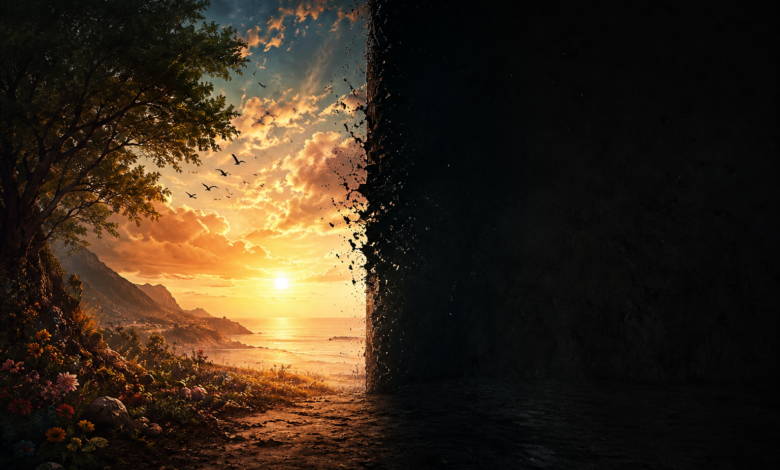
Let us assume for a moment that there is truly nothing after death. Consciousness does not continue, memories are not preserved, and experience does not persist in any form. One day, the final breath is taken, and from your perspective all experience comes to an end forever. At first glance, this idea seems straightforward. Yet when examined more closely, a strange problem emerges. If absolute nonexistence is truly possible, why does this experience exist at all right now?
Each of us is accustomed to treating our existence as though it were a natural and inevitable consequence of the universe. But when viewed from a distance, the situation becomes remarkably strange. For roughly 13.8 billion years, the universe existed without us. Stars were born and died, continents drifted across the planet, and countless species emerged and disappeared. Throughout all of that time, there was no experience from your perspective. Then, at some point, certain atoms in the universe arranged themselves in a particular way, and one day you opened your eyes and began experiencing the world. We are now told that this experience will eventually dissolve back into eternity. If there is only a brief flash of consciousness between an infinite before and an infinite after, then perhaps the thing that truly requires explanation is not the absence that follows death, but the existence of the flash itself.
Science offers several mechanisms that may explain how consciousness emerged. Neurons, synapses, information processing, evolutionary advantages—all of these provide pieces of the puzzle. Yet an important distinction is often overlooked. Explaining how the brain functions is not the same as explaining why subjective experience exists at all. No matter how thoroughly we examine electrical activity within the brain, we are still left with a profound question: Why do these physical processes become something that is felt from the inside? Why does the movement of atoms not remain merely the movement of atoms, but instead give rise to the subjective experience we call “I”?
For this reason, some philosophers consider consciousness to be one of the deepest mysteries in existence. Even if we were able to explain the entire universe through physical laws, we would still not have explained why observers capable of contemplating those laws emerged in the first place. Perhaps consciousness is not merely a byproduct of matter, as we often assume. Perhaps it arises from a more fundamental feature of reality that we do not yet understand. Some thinkers go even further, suggesting that consciousness may not be something that appeared late in the history of the universe, but something as fundamental as space, time, or energy itself. There is currently no strong evidence that such ideas are correct, but their existence reflects a growing recognition that our present explanations may still be incomplete.
There is an even deeper layer to the question. Imagine that after death there is an eternity of absolute nothingness. If consciousness can appear only once within that endless absence, then its appearance is already an extraordinary event. Logically, one might expect there to be no experience at all. Yet experience exists. Colors are seen, sounds are heard, memories are formed, and the universe has somehow become capable of asking questions about itself. Perhaps the greatest mystery is not what happens after death. Perhaps the greater mystery is why anything is being experienced in the first place within a reality where no experience seems necessary.
At this point the question becomes almost cosmological. Why is there a universe rather than nothing? Why can this universe produce life? Why can life produce consciousness? And why has that consciousness become sophisticated enough to contemplate its own ending? Perhaps all of these questions share a common answer. Perhaps they do not. Yet even the possibility that nothing awaits us after death opens the door to a larger and often overlooked mystery. If there is ultimately only darkness, then we must still explain why, for even a brief moment, there was light.
For the ending section, a natural English translation would be:
Perhaps what truly unsettles us is not death itself. The more disturbing mystery may be existence. Nonexistence requires no explanation. It is easy to imagine nothing at all. What demands an explanation is the fact that something exists right now.
For thousands of years, humanity has searched for answers about what happens after death. Yet it is possible that, in doing so, we have been circling around a much larger question. If one day we will disappear completely, why is there an experience here now? Why is there a universe capable of producing life, consciousness, and the ability to wonder about its own fate?
Perhaps the deepest mystery is not what awaits us after death, but what brought us into existence before it.
If our experience is destined to vanish, then the most profound question may not be where we go when it ends, but why it began at all.
And that question is not merely about death.
It may be one of the deepest questions that can be asked about reality itself.

