
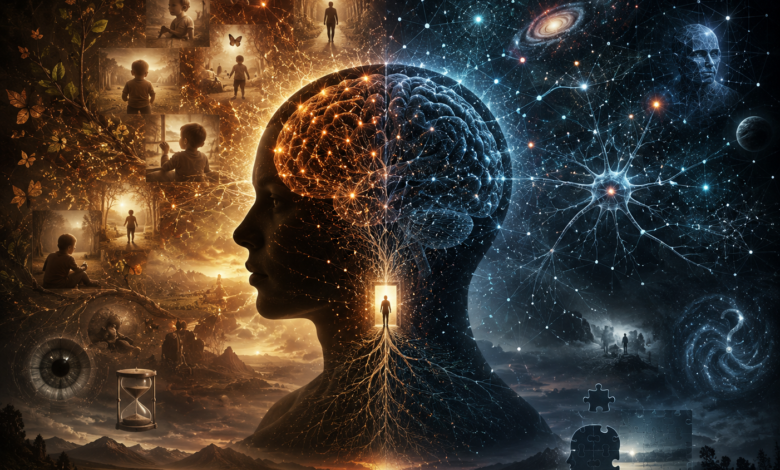
Perhaps one of the most frequently used words in our lives is “I.” I think. I feel. I decided. I am happy. I am afraid. We use this word so naturally that we rarely stop to ask what it actually refers to. It feels as though there is a single, unchanging entity inside us—a silent observer that has experienced every moment of our lives, from childhood until today. We assume that this same “self” has always been there, simply accumulating memories and experiences over time.
Yet despite how familiar this feeling is, science still cannot say with certainty what that “self” actually is.
Modern neuroscience has revealed more about the human brain than at any other point in history. We understand a great deal about how memories are formed, how decisions are made, how emotions arise, and which networks of neurons are involved in different mental processes. We know that the brain is an extraordinarily complex system composed of billions of neurons exchanging electrical and chemical signals every second. But all of this knowledge leads to a surprising conclusion.
There is no single place in the brain where the “self” appears to exist.
Vision is processed in one network. Hearing in another. Language, memory, attention, movement, and emotion all rely on different regions working together. The brain functions less like a single command center and more like an enormous city, where countless independent systems operate simultaneously. Yet despite this decentralization, we experience life as if there were only one person inside—one observer seeing through our eyes, thinking our thoughts, and making our decisions.
But is there really such an observer?
This question is far older than neuroscience itself. For thousands of years, philosophers have debated whether the self exists independently of the body or whether it is simply a product of physical processes. Some argued that the body is merely a vessel and that the true self exists beyond it. Others claimed that consciousness and identity emerge entirely from the activity of the brain.
As neuroscience advanced, the second view gained considerable support. Damage to surprisingly small regions of the brain can dramatically alter personality, memory, moral judgment, and even the sense of identity itself. A brain tumor can transform a gentle person into an aggressive one. A stroke can fundamentally change someone’s character. Some patients insist that one of their own arms does not belong to them. Others fail to recognize their own reflection in a mirror.
If the self is an independent, unchanging entity, why should small physical changes inside the brain affect it so profoundly?
Observations like these have led many scientists to a compelling possibility. Perhaps the self is not a separate entity hidden somewhere inside the brain. Perhaps it is a dynamic model—a continuously updated representation that the brain constructs in order to unify millions of separate processes into a single coherent experience.
But this explanation immediately raises another question.
Creating a model is not the same as having an experience.
A computer can monitor its own memory usage, processor temperature, and internal operations. It can store information about itself and even modify its own behavior. Yet no one believes the computer actually experiences those processes. It processes information without feeling anything.
The human brain appears to do something fundamentally different.
It does not merely process pain; it feels pain. It does not merely detect the color red; it experiences redness. It does not simply calculate the future; it worries about it. Most remarkably, it experiences itself as someone—a subject living through each of these events.
This is where one of the deepest mysteries in science begins.
How do electrical signals traveling between neurons become a first-person experience?
Despite decades of research, no brain scan has ever located the precise moment where subjective awareness begins. We can observe which regions become active when someone remembers a face, feels fear, or makes a decision. But nowhere in those measurements do we find an explanation for why these physical processes should be accompanied by conscious experience at all.
This is what philosophers call the hard problem of consciousness.
Perhaps even more puzzling is the remarkable sense of continuity we carry throughout life. Nearly every cell in our bodies is eventually replaced. The neural connections inside our brains are constantly reorganized. Our beliefs, values, personalities, and memories evolve over time. Biologically and psychologically, the person you were ten years ago is not identical to the person reading these words today.
And yet you still believe they are both you.
Does this continuity reveal the existence of an enduring self, or is it simply a story the brain continuously tells in order to preserve a stable identity?
Memory seems like an obvious answer, but it cannot be the whole explanation. People with severe memory loss often continue to experience themselves as the same person, despite forgetting much of their past. At the same time, someone can remember nearly everything while gradually becoming an entirely different individual.
So perhaps the self is not stored inside our memories.
Perhaps it is not located anywhere at all.
Perhaps it resembles a river—constantly changing while somehow maintaining the appearance of being the same river. Every drop of water moves on, yet we continue to give the river the same name. Maybe personal identity works in much the same way.
But even this analogy leaves one final mystery untouched.
We may be able to explain why the river changes.
What remains unexplained is why there is something experiencing the flow in the first place.
Perhaps there is no permanent self.
Perhaps our entire sense of identity is an extraordinarily convincing model constructed by the brain.
But if that is true, then what exactly is reading these words right now?
What is asking, “Who am I?”
Perhaps the greatest mystery humanity has yet to solve is not how the universe exists, but why the universe contains something capable of wondering about its own existence at all.
If Consciousness Is Only a Temporary Biological Process, What Is the “Self” We Call “Me”?
Perhaps one of the most frequently used words in our lives is “I.” I think. I feel. I decided. I am happy. I am afraid. We use this word so naturally that we rarely stop to ask what it actually refers to. It feels as though there is a single, unchanging entity inside us—a silent observer that has experienced every moment of our lives, from childhood until today. We assume that this same “self” has always been there, simply accumulating memories and experiences over time.
Yet despite how familiar this feeling is, science still cannot say with certainty what that “self” actually is.
Modern neuroscience has revealed more about the human brain than at any other point in history. We understand a great deal about how memories are formed, how decisions are made, how emotions arise, and which networks of neurons are involved in different mental processes. We know that the brain is an extraordinarily complex system composed of billions of neurons exchanging electrical and chemical signals every second. But all of this knowledge leads to a surprising conclusion.
There is no single place in the brain where the “self” appears to exist.
Vision is processed in one network. Hearing in another. Language, memory, attention, movement, and emotion all rely on different regions working together. The brain functions less like a single command center and more like an enormous city, where countless independent systems operate simultaneously. Yet despite this decentralization, we experience life as if there were only one person inside—one observer seeing through our eyes, thinking our thoughts, and making our decisions.
But is there really such an observer?
This question is far older than neuroscience itself. For thousands of years, philosophers have debated whether the self exists independently of the body or whether it is simply a product of physical processes. Some argued that the body is merely a vessel and that the true self exists beyond it. Others claimed that consciousness and identity emerge entirely from the activity of the brain.
As neuroscience advanced, the second view gained considerable support. Damage to surprisingly small regions of the brain can dramatically alter personality, memory, moral judgment, and even the sense of identity itself. A brain tumor can transform a gentle person into an aggressive one. A stroke can fundamentally change someone’s character. Some patients insist that one of their own arms does not belong to them. Others fail to recognize their own reflection in a mirror.
If the self is an independent, unchanging entity, why should small physical changes inside the brain affect it so profoundly?
Observations like these have led many scientists to a compelling possibility. Perhaps the self is not a separate entity hidden somewhere inside the brain. Perhaps it is a dynamic model—a continuously updated representation that the brain constructs in order to unify millions of separate processes into a single coherent experience.
But this explanation immediately raises another question.
Creating a model is not the same as having an experience.
A computer can monitor its own memory usage, processor temperature, and internal operations. It can store information about itself and even modify its own behavior. Yet no one believes the computer actually experiences those processes. It processes information without feeling anything.
The human brain appears to do something fundamentally different.
It does not merely process pain; it feels pain. It does not merely detect the color red; it experiences redness. It does not simply calculate the future; it worries about it. Most remarkably, it experiences itself as someone—a subject living through each of these events.
This is where one of the deepest mysteries in science begins.
How do electrical signals traveling between neurons become a first-person experience?
Despite decades of research, no brain scan has ever located the precise moment where subjective awareness begins. We can observe which regions become active when someone remembers a face, feels fear, or makes a decision. But nowhere in those measurements do we find an explanation for why these physical processes should be accompanied by conscious experience at all.
This is what philosophers call the hard problem of consciousness.
Perhaps even more puzzling is the remarkable sense of continuity we carry throughout life. Nearly every cell in our bodies is eventually replaced. The neural connections inside our brains are constantly reorganized. Our beliefs, values, personalities, and memories evolve over time. Biologically and psychologically, the person you were ten years ago is not identical to the person reading these words today.
And yet you still believe they are both you.
Does this continuity reveal the existence of an enduring self, or is it simply a story the brain continuously tells in order to preserve a stable identity?
Memory seems like an obvious answer, but it cannot be the whole explanation. People with severe memory loss often continue to experience themselves as the same person, despite forgetting much of their past. At the same time, someone can remember nearly everything while gradually becoming an entirely different individual.
So perhaps the self is not stored inside our memories.
Perhaps it is not located anywhere at all.
Perhaps it resembles a river—constantly changing while somehow maintaining the appearance of being the same river. Every drop of water moves on, yet we continue to give the river the same name. Maybe personal identity works in much the same way.
But even this analogy leaves one final mystery untouched.
We may be able to explain why the river changes.
What remains unexplained is why there is something experiencing the flow in the first place.
Perhaps there is no permanent self.
Perhaps our entire sense of identity is an extraordinarily convincing model constructed by the brain.
But if that is true, then what exactly is reading these words right now?
What is asking, “Who am I?”
Perhaps the greatest mystery humanity has yet to solve is not how the universe exists, but why the universe contains something capable of wondering about its own existence at all.

