There are very few things that human beings accept throughout their lives without ever questioning them. Time is perhaps one of the most fundamental.
Morning turns into evening. Children grow up. People grow old. Stars are born and eventually die. Clocks keep ticking, and calendars continue to change. All of these experiences lead us to believe that time is constantly flowing. It feels so natural that most people never stop to ask whether time actually exists at all.
Yet as modern physics has advanced, it has arrived at a fascinating possibility. Some of the most successful theories describing our universe suggest that time may not be as fundamental as we once believed. Perhaps time is not one of the basic building blocks of reality, but rather an experience that emerges from a deeper underlying structure.
At first glance, this idea may sound like science fiction. Today, however, it is no longer merely a philosophical question. It has become one of the most profound subjects of research for physicists, cosmologists, and neuroscientists alike.
So, does time really flow? Or is it only we who are moving through it?
Do We Really See Time?
No one has ever seen time directly.
What we actually see is change.
A candle melting. Leaves turning yellow. A heart beating. A cup of coffee cooling. These are all examples of change. By observing these changes, we say, “Time has passed.”
In reality, however, even clocks do not measure time itself.
- A mechanical clock counts the movement of gears driven by the gradual release of a wound spring.
- An atomic clock counts the microwave frequency generated when electrons in a cesium-133 atom transition between two energy levels. In fact, one second is officially defined as 9,192,631,770 of these transitions.
- A sundial measures the Sun’s apparent movement across the sky.
- A pendulum clock counts the back-and-forth oscillations of a pendulum.
- A quartz clock counts the vibrations of a quartz crystal when an electric current is applied. Typically, it produces 32,768 vibrations per second.
In other words, there is nothing inside a clock that literally “flows” as time. A clock simply counts recurring physical events—it measures change.
Perhaps what we call time is nothing more than a mental concept we have developed to describe change.
This subtle distinction is far more important than it may first appear. Because if change can be described without time itself, then the question of whether time exists as an independent feature of reality becomes open to debate.
Newton’s Concept of Time
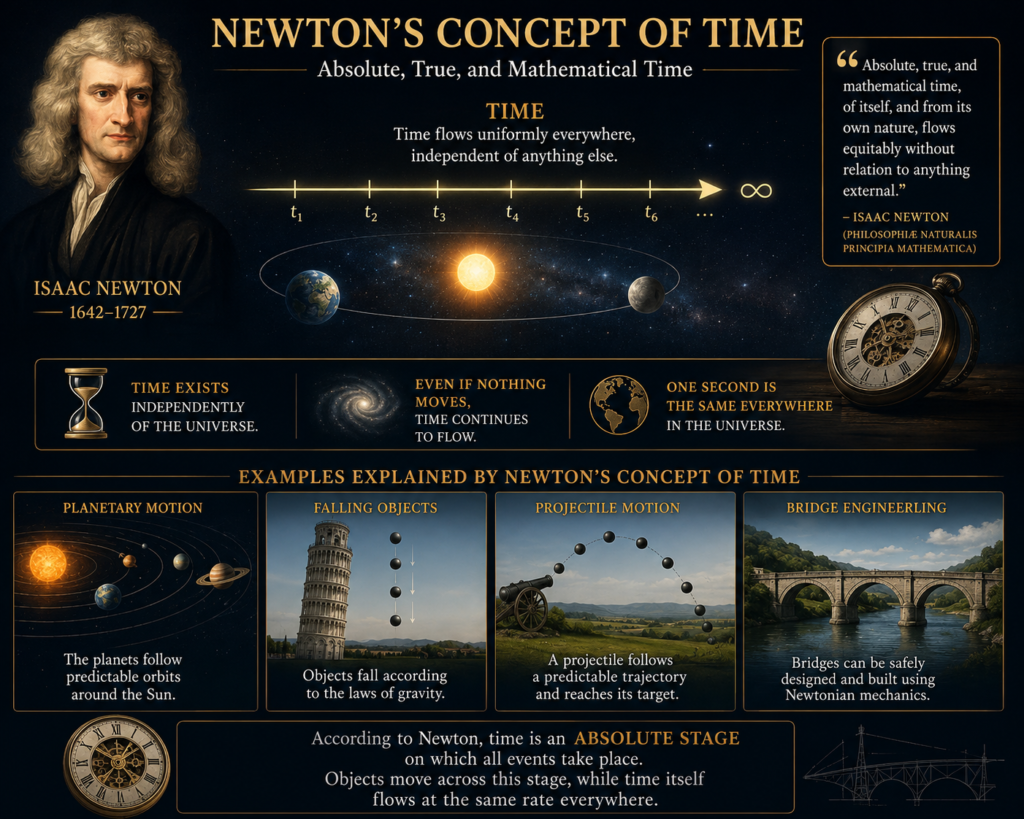
For Isaac Newton, time was an absolute reality that existed independently of the universe itself.
According to his view:
Time flows uniformly everywhere, completely independent of anything else.
Newton summarized this idea in his work as follows:
“Absolute, true, and mathematical time, of itself, and from its own nature, flows equably without relation to anything external.”
This view leads to several important conclusions:
- Even if nothing in the universe were moving, time would continue to flow.
- Time exists whether or not anyone observes it.
- One second on Earth is exactly the same as one second in a distant corner of the galaxy.
- Clocks do not create time; they merely attempt to measure the absolute time that is already flowing.
For everyday life, this understanding proved remarkably successful.
The structural integrity of bridges was calculated using Newtonian mechanics.
The motion of the planets around the Sun could be accurately predicted.
The Moon’s orbit around the Earth could be calculated.
The trajectory of a cannonball could be determined.
However, the universe turned out to be far more complex than everyday experience. Once light entered the picture, everything began to change…