
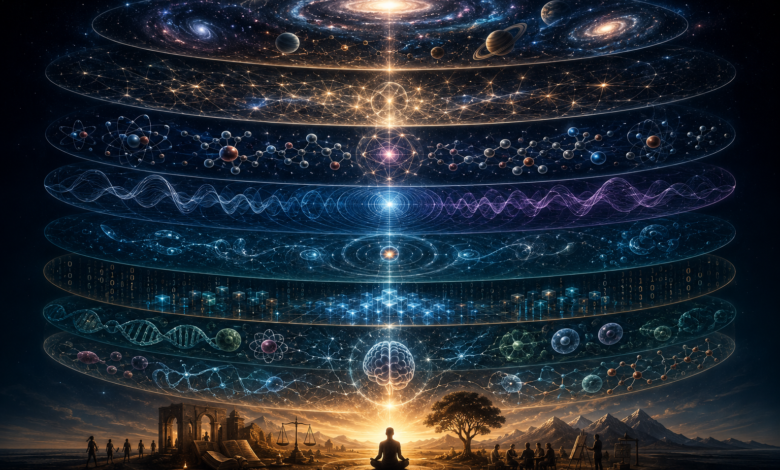
The Layers of Reality
Reality today is no longer explained through a single scientific discipline.
Humanity attempts to understand existence by examining reality through different scales, layers, and levels of abstraction.
Because of this, modern thought is not truly a single “model of reality,” but rather a structure composed of interconnected physical, biological, cognitive, and philosophical layers.
1. Cosmological Layer
The Macrostructure of the Universe
This level examines reality at its largest possible scale.
Structures Studied
- Galaxies
- Superclusters
- Black holes
- The cosmic web
- Dark matter
- Dark energy
- Space-time geometry
Main Disciplines
- Cosmology
- Astrophysics
- Relativistic physics
- Gravitational theories
Major Theories
- The Big Bang Model
- Cosmic Inflation
- The ΛCDM Model
- General Relativity
In Einstein’s framework, mass is not merely matter;
it bends the geometry of space-time itself.
Gμν+Λgμν=c48πGTμν
Here, the universe is no longer seen as “objects floating in emptiness,”
but as a dynamic fabric of space-time.
2. Atomic and Molecular Layer
The Organization of Matter
At this level, reality is reduced to:
- atoms,
- electronic structures,
- molecular bonds.
Main Disciplines
- Atomic physics
- Chemistry
- Molecular physics
- Thermodynamics
Structures Studied
- Electron orbitals
- Chemical bonds
- Entropy
- Energy transfer
At this scale, what we perceive as “solid matter” is understood to be mostly empty space.
When the distance between the atomic nucleus and electrons is scaled proportionally,
most of what we call matter becomes vast emptiness.
3. Quantum Layer
The Probabilistic Nature of Reality
Classical physics begins to collapse here.
Particles:
- can exist in multiple states simultaneously,
- behave probabilistically rather than deterministically,
- appear to change through observation.
Main Disciplines
- Quantum mechanics
- Quantum electrodynamics (QED)
- Quantum chromodynamics (QCD)
Core Concepts
- Superposition
- Wave function
- Uncertainty principle
- Quantum entanglement
ΔxΔp≥2ℏ
This equation states that position and momentum cannot both be known with infinite precision simultaneously.
At this level, reality no longer behaves like “definite objects,”
but more like probability distributions.
4. Quantum Field Layer
The Field Reality Beneath Particles
According to modern physics, fundamental reality may not consist of “particles” at all.
The current understanding suggests:
- the universe is fundamentally composed of fields,
- particles are excitations or vibrations within those fields.
For example:
- electron = excitation of the electron field
- photon = quantum of the electromagnetic field
Main Disciplines
- Quantum Field Theory (QFT)
- The Standard Model
- Gauge theories
Structures Studied
- The Higgs field
- Bosons
- Quarks
- Leptons
- Vacuum fluctuations
[ E = mc^2 ]
Matter and energy become interchangeable.
At this level, even “empty space” is not truly empty.
The vacuum itself is thought to constantly generate virtual particle fluctuations.
5. Information Layer
Could Information Be More Fundamental Than Matter?
Some modern approaches suggest that even matter itself may emerge from something deeper: information.
Related Fields
- Information theory
- Computational physics
- Digital physics
- Complexity theory
Approaches
- “It from Bit” — John Wheeler
- Simulation hypothesis
- Computable universe models
The central question here becomes:
Is the universe a physical structure,
or an information-processing system?
Problems such as the black hole information paradox suggest that information may play a fundamental role in physical reality.
6. Biological Layer
The Transition from Non-Life to Life
This level examines how chemistry transformed into biology.
Main Disciplines
- Evolutionary biology
- Molecular biology
- Biochemistry
- Synthetic biology
Major Questions
- How did the first RNA emerge?
- How did the first cell form?
- Why did consciousness evolve?
At this stage, reality begins transforming into self-replicating systems.
DNA is no longer merely chemistry;
it becomes a physical system capable of storing and transmitting information.
7. Neuroscientific Layer
Perceived Reality
The brain does not directly perceive the external world.
Instead, it:
- processes signals,
- generates predictions,
- fills in missing information,
- constructs an internal simulation of reality.
Main Disciplines
- Neuroscience
- Cognitive science
- Computational neuroscience
Approaches
- Predictive Processing
- Bayesian Brain Theory
- Integrated Information Theory
The essential question becomes:
Is the world we perceive truly external reality,
or a model constructed by the brain?
8. Consciousness Layer
The Problem of Subjective Experience
Consciousness remains one of the greatest unsolved problems.
Core Problems
- The problem of qualia
- The Hard Problem of Consciousness
- The formation of selfhood
- Subjective experience
Approaches
- Panpsychism
- Physicalism
- Dualism
- Emergentism
- Orch-OR theory
At this level, physics and philosophy begin approaching one another.
Because:
we still do not understand why atoms should produce “experience” at all.
9. Ontological Layer
The Nature of Being Itself
At this point, we move beyond physics.
Questions Explored
- What does it mean “to exist”?
- Is true nothingness possible?
- Is mathematics discovered or invented?
- Is time fundamentally real?
Main Fields
- Ontology
- Metaphysics
- Phenomenology
Here, reality stops being purely measurable
and becomes increasingly conceptual.
10. Meaning Layer
Why Do Humans Project Meaning onto Reality?
The universe may be physical.
But:
- love,
- death,
- fear,
- value,
- purpose,
- meaning,
cannot easily be reduced to physical equations alone.
Main Fields
- Existentialism
- Psychology
- Philosophy of religion
- Philosophy of language
At this level, humanity — despite emerging from a biological process within the universe — begins questioning the meaning of the universe itself.
And perhaps the central question of BeforeMeaning emerges precisely here:
At what point did reality begin producing meaning?

